
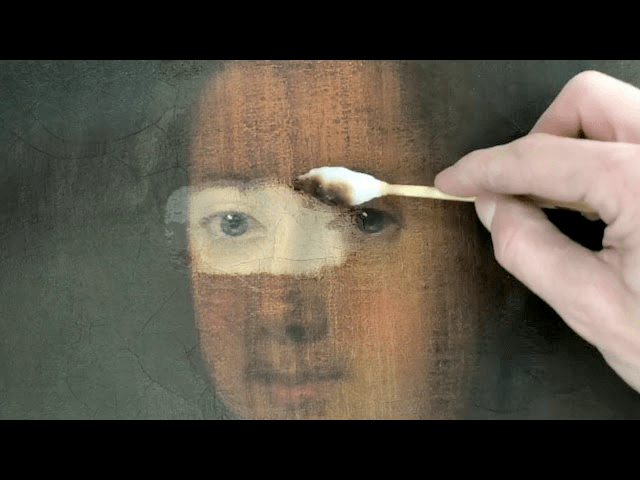
For centuries, art restoration has been a painstaking craft, requiring conservators to meticulously repair damaged paintings by hand—stroke by stroke, shade by shade. A single work can take months, even years, to restore. But now, a groundbreaking method developed at MIT could revolutionize the field, allowing masterpieces to be physically restored in just hours using digitally generated films that can be removed if needed.
In a study published today in Nature, Alex Kachkine, a mechanical engineering graduate student at MIT, unveils a technique that bridges the gap between digital restoration and physical conservation. His method involves scanning a damaged painting, using artificial intelligence to analyze its flaws, and then printing a precise, ultra-thin polymer “mask” that adheres to the original artwork—effectively restoring it without permanent alteration.
A Digital Solution to an Age-Old Problem
Traditional restoration is slow and labor-intensive. Conservators must identify every crack, scratch, and missing pigment, then mix and apply paints that match the original work. Digital tools have accelerated the process in recent years, allowing for virtual reconstructions, but these have remained purely digital—until now.
Kachkine’s innovation lies in translating these digital restorations into physical form. His method begins with a high-resolution scan of the damaged painting, which AI then analyzes to determine the original colors and patterns. The system generates a map of defects—green lines for splits in the panel, red for major cracks, blue for paint losses, and pink for minor scratches. A two-layer polymer film is printed with the restoration: one layer in color, the other in white to ensure accurate hue reproduction. The mask is then carefully aligned and adhered to the painting using a removable varnish.
Crucially, the film can be dissolved later, leaving the original artwork untouched. “Because there’s a digital record of what mask was used, in 100 years, the next conservator will know exactly what was done,” Kachkine says. “That’s never really been possible before.”
Speed and Precision
To demonstrate the method, Kachkine restored a heavily damaged 15th-century oil painting. The AI identified 5,612 regions requiring repair and filled them with 57,314 distinct colors—a process completed in just 3.5 hours. By contrast, a similar restoration done by hand would take roughly nine months of part-time work.
The implications are profound. Museums and galleries house countless damaged works too costly or time-consuming to restore. “There is a lot of damaged art in storage that might never be seen,” Kachkine says. “This could change that.”
Ethical Considerations
Yet the method raises questions. How much restoration is too much? Does an AI-assisted repair truly honor the artist’s intent? Kachkine emphasizes that conservators must guide the process. “It will take deliberation to ensure this aligns with conservation principles,” he says.
The project began as a personal passion. An avid art restorer himself, Kachkine was struck by how much art remains hidden due to damage. “If we could restore digitally and apply it physically,” he thought, “that would resolve so many challenges.”
Now, his vision may soon bring forgotten masterpieces back to life—faster than ever before.



 AI News Monitor
Leave a comment