
Google is releasing a feature that lets AI do Internet search for you, but it may cause more harm than good.
Google has launched a new search feature called AI Mode, which uses AI to browse the web for users. The tech giant promises that AI Mode will help users “access more breadth and depth of information than a traditional search on Google.”
AI Mode functions like a chatbot. Users can ask questions and Google scours through different sites, and then presents a concise answer. Users can then ask follow-up questions if need be.
The feature removes the need for multiple keyword searches and saves time spent scrolling through website links and reading previews to find the right information. It also combines results from different sources to provide more fleshed-out responses.
Robby Stein, Google’s vice president of product for Search, said that AI Mode “expands what AI Overviews can do with more advanced reasoning, thinking and multimodal capabilities so you can get help with even your toughest questions.”
The new feature is available only to Google One AI subscribers for now. It can be found on Google’s Search page as a separate tab that users can switch to, just like with the “Images” or “News” sections.
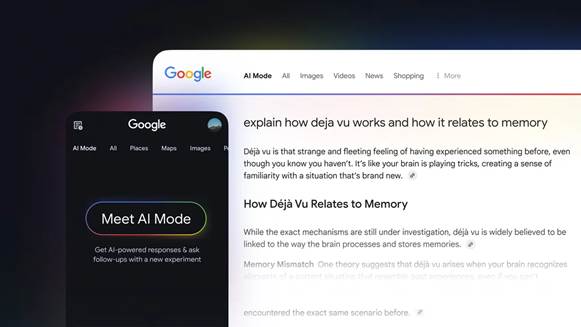
Google’s AI Mode appears as a separate tab that users can access for AI-summarized results. Image credit: Google
Analysts say that Google is hoping to use AI Mode to compete with OpenAI’s ChatGPT as well as Perplexity AI. OpenAI updated ChatGPT in October of last year to include real-time internet search, which has threatened Google’s dominance. Google’s President and Chief Investment Officer, Ruth Porat, said in response that turning to AI was the company’s “biggest bet.”
However, there are concerns that the feature will steal traffic from content developers on the web, as visitors can find information they need directly from AI Mode and have no need to visit the websites. Google has promised that links to sources will be clearly visible in search results. But critics insist that users may see no need to click on the links if they already have the information they need.
This comes only a few weeks after Google was sued by education company, Chegg, for eroding demand for its content. The company is arguing that Google is scraping its content to present to users on the Search page and leaving it short.
According to Chegg CEO, Nathan Schultz, the company is also concerned about more than just its own profits.
“It’s about the digital publishing industry, the future of internet search, and about students losing access to quality, step-by-step learning in favor of low-quality, unverified AI summaries,” said Schultz.
There have been questions about whether Google needs to strike copyright deals so as to benefit those who own the content. However, such a deal is difficult to see, as Google already claims that both its AI Overviews and AI Mode are sending “billions of clicks to sites across the web.”
Web users may understandably fear for the future of search. Many have long expected Internet search to ultimately change from a list of websites generated through keywords to a conversation-style search using AI. Yet there are serious questions to be asked about whether web content creators would have any reason to continue doing so if it was no longer rewarding for them.
Web content creators have typically produced content to gain income from Google AdSense or to draw traffic to their websites. Google’s helpful new mode threatens to take all that away.







Leave a Reply