
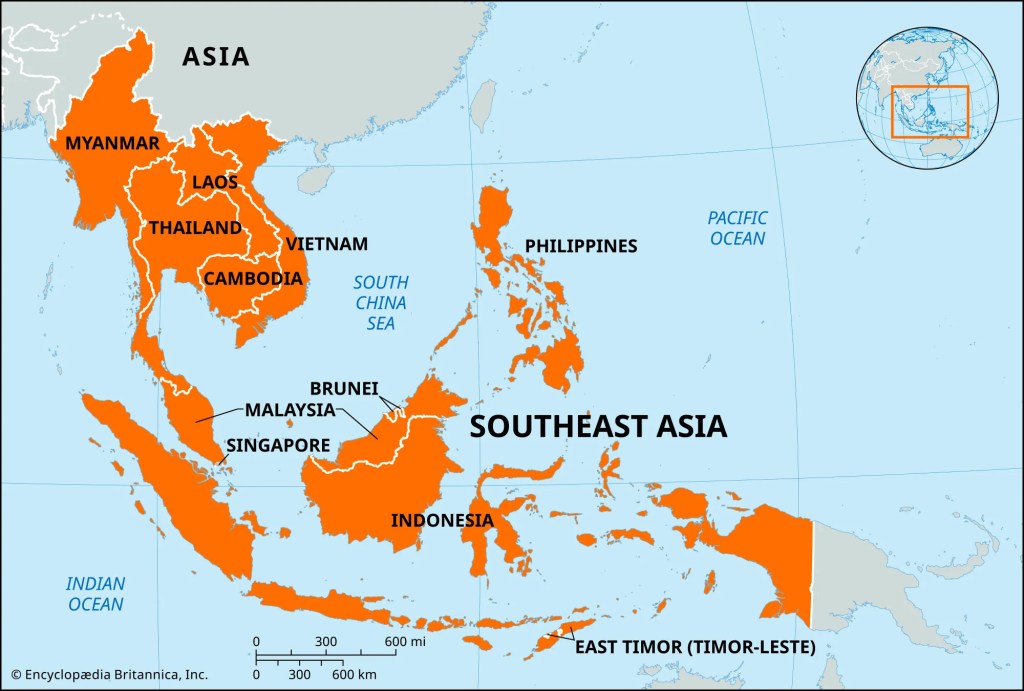
In recent years, high-profile international efforts to govern artificial intelligence (AI) have surged, with initiatives like the G20 Hiroshima Process, the global AI summits in Bletchley Park, Seoul, and Paris, and the OECD AI principles taking center stage. However, these discussions have largely been driven by a handful of powerful nations, leaving many regions, including Southeast Asia, with limited representation. As AI continues to reshape economies, societies, and security landscapes worldwide, the exclusion of Southeast Asia from these critical conversations poses significant risks—not only for the region but for the global community as well, according to a commentary published on the Brookings.
A Transformative Technology with Unequal Access
AI holds immense potential for Southeast Asia, a region of over 680 million people. It could accelerate scientific research, improve public services, and drive economic growth. However, the benefits of AI come with heightened risks, particularly as the technology proliferates among malicious actors. For instance, AI-powered scams and cyber operations are already on the rise, threatening the region’s digital security. Despite these challenges, Southeast Asia has been largely sidelined in global AI governance discussions. While Singapore chaired a session at the Bletchley Park summit, other key players like Thailand and Vietnam were absent altogether.
This lack of representation has real consequences. As the adage goes, “If you’re not at the table, you’re on the menu.” Without a seat at the table, Southeast Asia risks being disproportionately affected by the downsides of frontier AI systems—highly capable, general-purpose AI models like OpenAI’s reasoning systems. These systems, while transformative, could exacerbate existing vulnerabilities in the region, from cybersecurity threats to economic inequality.
Southeast Asia’s Emerging AI Safety Efforts
Despite being underrepresented globally, Southeast Asia is not sitting idle. The Association of Southeast Asian Nations (ASEAN) has released a framework outlining principles for AI governance, with a specific focus on generative AI. Singapore, a regional leader in AI development, has established the Singapore AI Safety Institute (AISI), which participated in the first international pilot for testing foundation models alongside U.S. and U.K. counterparts.
Efforts are also underway to address multicultural and multilingual safety concerns. For example, the Typhoon2-Safety classifier has been developed to safeguard text generation in Thai, a critical step given that prompts in less commonly used languages can bypass safety measures in large language models (LLMs). This work highlights the importance of localizing AI safeguards to ensure they are effective across diverse linguistic and cultural contexts.
The Scammer’s AI Apprentice: A Regional Threat
One of the most pressing concerns for Southeast Asia is the misuse of AI by criminal networks. The region is already a hotspot for organized crime, including scams and human trafficking. According to a UN report, hundreds of thousands of people are involved in scam operations, with many trafficked into the industry. Generative AI could amplify these threats by enabling scammers to impersonate legitimate actors at scale, using voice cloning, deepfakes, and persuasive chatbots to deceive victims.
While current AI systems still require human oversight, the emergence of autonomous AI agents could take these threats to a new level. These systems, capable of executing tasks with minimal human intervention, could allow criminal networks to operate on an unprecedented scale. Although proof-of-concept experiments show that current AI agents are only moderately successful in executing scams, their rapid evolution poses a significant risk.
Bridging the Gap: A Call for Global Collaboration
To address these challenges, Southeast Asia must be more deeply integrated into global AI governance efforts. Transatlantic initiatives led by the U.S. and U.K. should actively partner with Southeast Asian stakeholders to leverage regional expertise and address unique threats. Collaboration could take many forms, from localizing safety features in Southeast Asian languages to sharing compute resources and fostering talent exchange.
Civic tech initiatives also offer a promising avenue for broadening public engagement in AI governance. By using digital tools to facilitate collective decision-making, Southeast Asian countries can ensure that their citizens have a voice in shaping the future of AI. For example, platforms like Polis, which have been used in pilot projects to map consensus on AI governance issues, could be adapted to the region’s needs.
Building Capacity for the Future
Southeast Asia’s ability to engage meaningfully in AI governance will depend on its capacity to develop local talent and infrastructure. This includes investing in stable internet access, energy supply, and advanced computing resources. Partnerships with frontier AI companies and Western nations could help bridge the gap, providing compute credits for training local models and supporting safety research.
Moreover, the region must prioritize public education and awareness around AI. Low levels of AI literacy in many Southeast Asian countries make it difficult for the public to advocate for their interests. By fostering dialogue and lowering barriers to participation, governments can ensure that AI governance reflects the needs and values of their citizens.
A Shared Responsibility
As AI continues to evolve, the risks and opportunities it presents will be felt worldwide. Southeast Asia’s exclusion from global AI governance discussions is not just a regional issue—it is a global one. By engaging Southeast Asia as an equal partner, the international community can build a more inclusive and resilient framework for AI governance.
The path forward requires an “all hands on deck” approach. From localizing safeguards to fostering talent and expanding public participation, Southeast Asia has a critical role to play in shaping the future of AI. As the region works to address its unique challenges, it also offers valuable insights and expertise that can benefit the global community. In the race to harness AI’s potential, collaboration is not just an option—it is a necessity.






Leave a Reply