
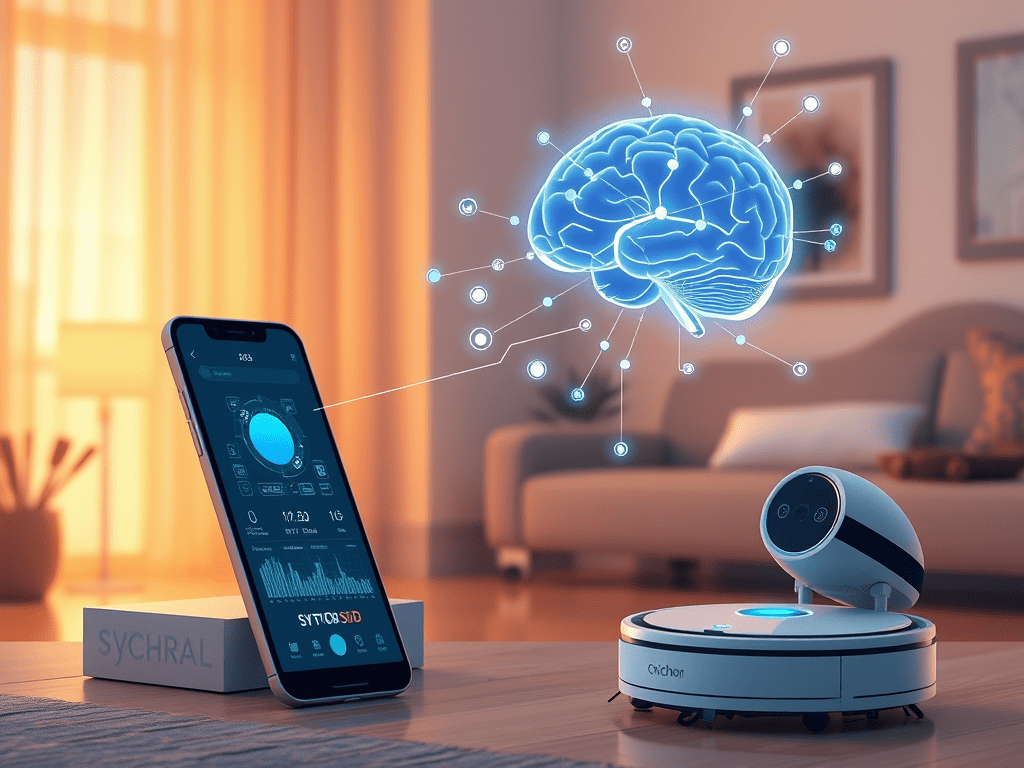
The AI model developed by Synchron can be trained directly using human thought, as company races to deliver life-changing solution to people with paralysis.
Synchron, a neurotechnology company, is in advanced stages with a new tool that lets people control technology with their minds. Based in Brooklyn, the company is being funded by a group of investors that includes Jeff Bezos and Bill Gates. The latest model it is developing will use AI trained directly using people’s thoughts instead of data from the internet.
With Synchron’s tool, Chiral, which is named after the Greek word for hand, people with severe paralysis can still interact with their environment. It works by transferring signals from people’s brains directly to smart devices such as smartphones, TV, and robot vacuum cleaners. The technology requires a device to be implanted into the brain in a procedure Synchron co-founder and CEO Tom Oxley described as “minimally invasive.” The device reads electrical activity in the brain and then converts that activity into commands for smart devices around the user.
The system uses a mixture of various technologies, including Nvidia’s supercomputers and Apple Vision Pro. With computer vision, Apple Vision Pro can recognize visual information in the person’s environment. It then transfers the data to the Nvidia supercomputer, which translates it to commands that can be sent to digital devices.
Rodney Gorham, a man living with a neural disease that has cost him the ability to use his arms or voice, is one of the first people to use Chiral. With the technology, he can play music, adjust temperature, turn lights on and off, send texts to his wife, and even feed his dog, using only his thoughts.
A plan is underway to improve Chiral further. According to Oxley, the company is building a model that uses AI to learn directly from an individual’s brain activity. The AI model will learn from a person’s action in particular environments and situations. This means that overtime the technology will come to understand what a person’s brain would do in a certain environment. It can then begin to recognize their intent and respond faster.
Synchron is now preparing to scale up its program from a handful of users to a 30 to 50-person trial. If successful, this would allow the New York-based company to push for a commercial launch.
However, Synchron is not the only company developing this technology. Neuralink, founded by Elon Musk, is also conducting trials with neurotechnology. So far, the company has raised over $600 million, which dwarfs the $145 million investment in Synchron. It has channeled most of this money into research and development. Neuralink first inserted an interface device in a human brain in 2024, five years after Synchron. There is a possibility that the Musk-led company could outpace Synchron and launch before it.
However, Oxley is optimistic about the level of impact that the company could make, not just on people with severe paralysis, but on the future of technology and AI as a whole. “Synchron’s vision is to scale neurotechnology to empower humans to connect to the world,” he said. “Through this work, we’re setting a new benchmark for what [this technology] can achieve.”
In a statement, the company claimed that its innovation will open the door for the next step in AI evolution. “Chiral will evolve into a self-learning model of cognition, representing the next leap beyond Generative AI and Agentic AI into the era of Cognitive AI,” it said.






Leave a Reply