
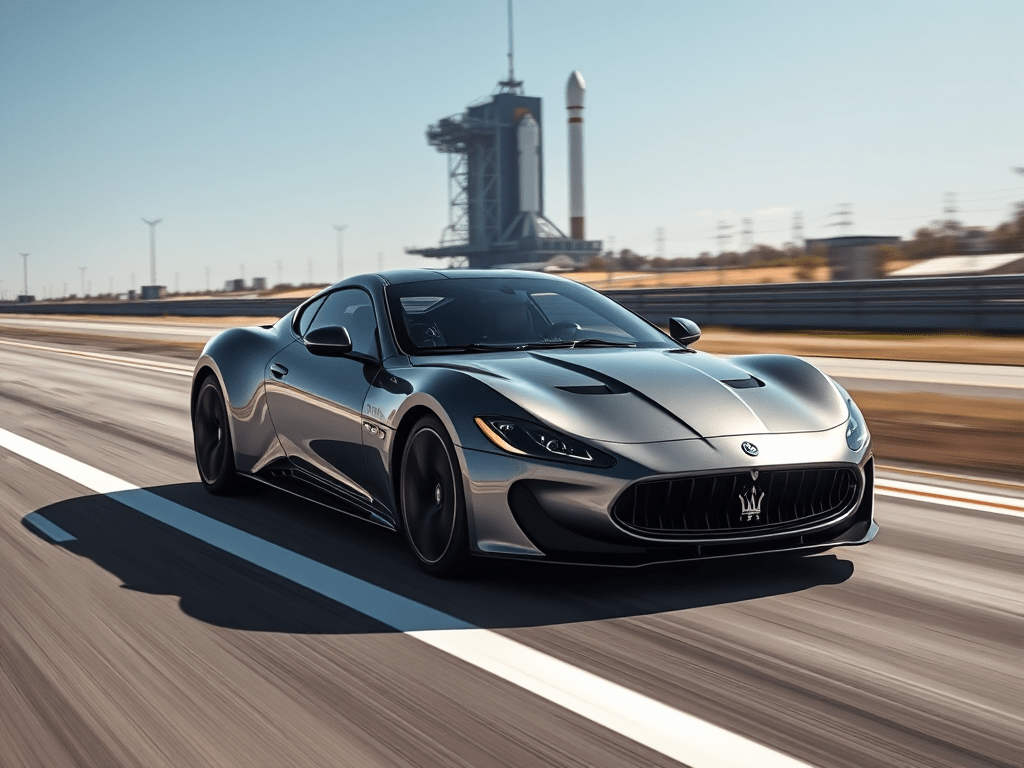
The driverless car hit up to 197.7 mph on Florida runway—and experts say the streets are next.
A Maserati MC20 Coupe has set a new speed record for self-driving cars after reaching a top speed of 197.7 mph. The driverless car achieved the feat on the runway at the Kennedy Space Center, Florida.
The AI software was developed by collaboration of a team of students and faculty from the Politecnico di Milano. The Politecnico di Milano is Italy’s largest technological university, and Michigan State University. Operating under the team name PoliMOVE-MSU, the group is focused on developing and improving software for autonomous driving. The speed challenge was a collaboration between the Politecnico di Milano, Maserati, the Indy Autonomous Challenge, and the 1000 Miglia Experience Florida.
The Indy Autonomous Challenge (IAC) is a group that organizes racing events for university teams to test self-driving cars. The aim is to provide an environment where they can compete and improve their algorithms. Self-driving cars rely on advanced AI algorithms to navigate and make decisions. For example, using deep learning, the AI program can recognize roads and detect objects to avoid. However, the cars can also be driven by a human driver without the AI software.
The previous speed record for autonomous cars was held by the PoliMOVE team. It was set at the Indy Autonomous Challenge in 2022. On that occasion, a Dallara AV-21 race car with AI software designed by the crew managed to reach a speed of 192.8 mph. This latest achievement breaks the previous record by a difference of 4.9 mph.
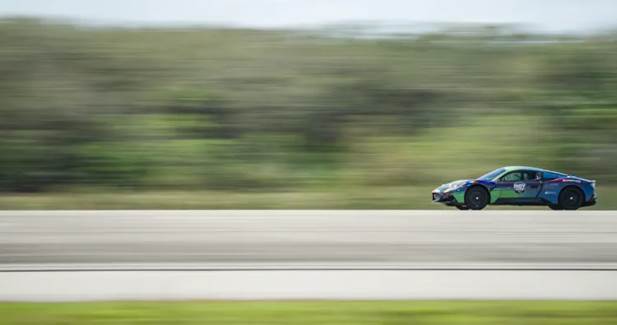
The Maserati sped down the Kennedy Space Center runway at 197.7 mph, without a human sitting in it.
Professor Sergio Savaresi, scientific director of the project, says that the achievement demonstrates the stability and robustness of the algorithms developed for autonomous driving. At a speed of nearly 200 mph, the software has shown incredible sharpness and reliability. The crew plans to use the technology to improve AI systems that drive at low speed in urban areas.
“The goal of high-speed tests is to evaluate the behavior of robo-drivers in extreme conditions,” says Savaresi. He believes that if autonomous vehicles can drive safely at incredible speeds, then the same system can be used to operate in a very safe way at normal speeds. The team will now be working on improving self-driving cars to be safer and more reliable on regular streets.



 AI News Monitor
Leave a comment