
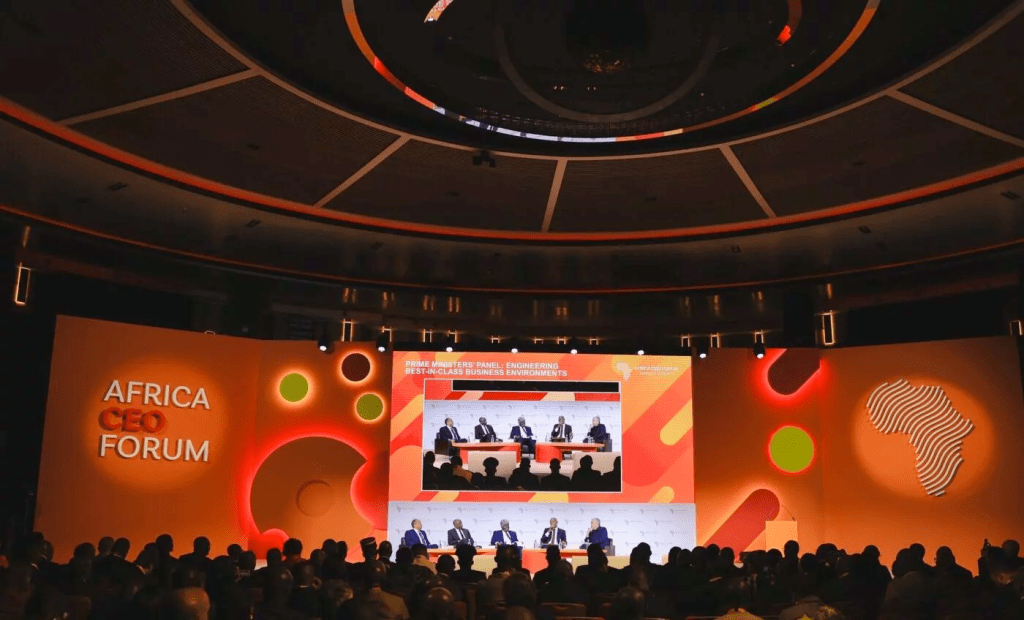
As artificial intelligence rapidly transforms economies worldwide, African leaders at the 12th Africa CEO Forum grappled with how the continent can carve out its own regulatory framework—one that fosters innovation while safeguarding sovereignty and local needs.
Held on May 12–13, the forum brought together more than 2,800 business leaders, policymakers, and six African heads of state to discuss the continent’s development priorities, with AI, energy security, and infrastructure dominating the agenda.
AI: Africa’s Race to Regulate Without Falling Behind
With AI reshaping industries from healthcare to finance, African nations are under pressure to establish governance frameworks that prevent reliance on foreign tech giants.
Franck Kié, founder of the Cyber Africa Forum, noted progress, citing Benin and Rwanda as countries that have already adopted national AI strategies. “The African Union also initiated a continental approach in 2024,” he said.
Catherine Muraga of Microsoft Africa Development Center emphasized the need for inclusivity in AI development. “We’re building tools in Kiswahili, Amharic, Yoruba, and other languages to ensure no one is left behind,” she said. “Africa has nearly 2,000 languages—this isn’t just about technology, but representation.”
Experts agreed that without accelerated investment and governance, Africa risks ceding control over its digital future to external players.
Nuclear Energy Gains Momentum as a Sustainable Solution
While AI dominated tech discussions, nuclear energy emerged as a key contender in Africa’s quest for reliable and clean power. Loyiso Tyabashe, CEO of South Africa’s Nuclear Energy Corporation (Necsa), argued that nuclear must complement renewables to meet the continent’s growing energy demands.
“Nuclear provides baseload power essential for industrialization,” Tyabashe said, pointing to South Africa’s decades-long experience with nuclear energy as proof of its affordability and low carbon footprint.
He also highlighted the potential of Small Modular Reactors (SMRs)—smaller, more flexible nuclear units that could suit countries with less developed power grids. “It’s not one-size-fits-all,” he noted.
A forum poll revealed that 73% of attendees saw nuclear as a viable energy solution for Africa, signaling a potential shift in the continent’s energy strategy.
Infrastructure: The Unfinished Foundation
No development can occur without robust infrastructure, panelists stressed. Mohammed Diop of AGL highlighted how 30-40% of Africa’s agricultural produce is lost before reaching markets, underscoring the need for better logistics and storage.
Meanwhile, Schneider Electric announced partnerships to boost industrial electrification, aligning with the African Continental Free Trade Area (AfCFTA) goals.
As the forum concluded, one message was clear: Africa must act swiftly—on AI governance, energy diversification, and infrastructure—to secure its place in the global economy.


 AI News Monitor
Leave a comment