
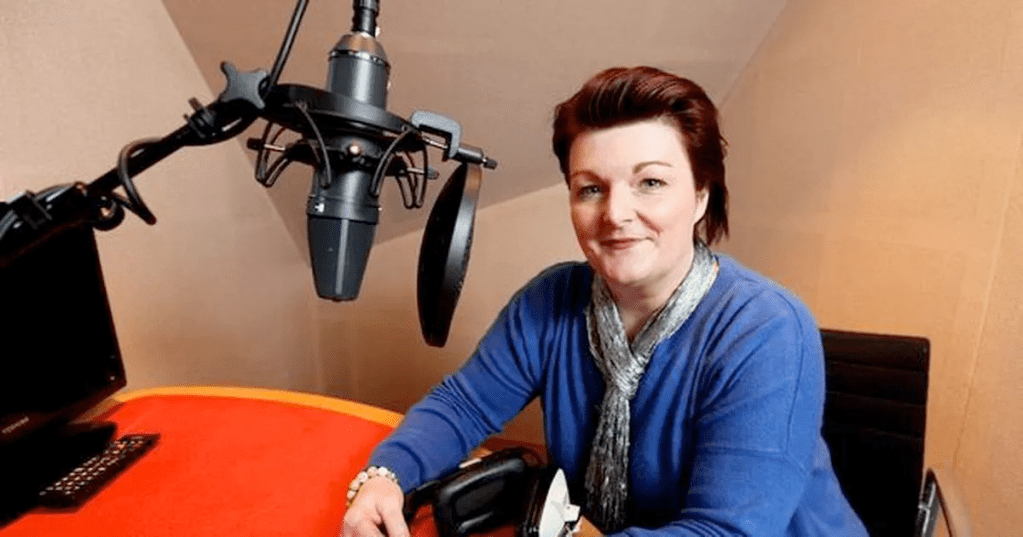
A Scottish voiceover artist has accused a technology company of repurposing her voice without proper consent, after discovering it had been used to develop ScotRail’s new AI-generated announcement system.
Gayanne Potter, an established voice actor, believes her voice was used to create “Iona,” a synthetic announcer recently introduced on trains operated by Scotland’s national rail service. The character—marketed by ReadSpeaker, a Swedish AI firm—as a red-haired woman standing in a glen, now delivers real-time announcements across ScotRail’s network.
“It is my voice—I’m absolutely certain,” said Ms. Potter in an interview. “I was horrified—the quality of it was dreadful.”
Potter claims she provided recordings to ReadSpeaker in 2021 under the impression they would be used for accessibility and educational tools. She said she had no knowledge they would later power a public-facing AI persona. “I would never have agreed to anything like this,” she said. “Why would I give away my voice, only for it to replace me?”
The discovery came two years after the original recording session, when a friend sent her a link to ReadSpeaker’s promotional page featuring Iona. Last week, Ms. Potter learned through a BBC Scotland story that the voice had been rolled out on ScotRail’s trains.
The voice has not been universally welcomed. Some passengers criticized its robotic tone. “I could tell it was AI,” one rider said. “It was weird.”
ScotRail declined to intervene in the dispute, describing it as a matter between Ms. Potter and ReadSpeaker. “We have no plans to remove Iona,” a spokesperson said.
ReadSpeaker, in a statement, maintained it had “comprehensively addressed” Ms. Potter’s concerns through her legal counsel. It added that all its AI voices are trained using “human voice talent.”
Legal experts say the case underscores a growing gap between technological capability and current legal protections. Jennifer Cass, a partner at law firm Dentons, noted that UK copyright law protects literary and artistic works, but not an individual’s voice or likeness.
“At the moment, there is no protection for image and voice in the UK,” said Ms. Cass. She added that the issue is under review in the context of a government consultation on AI and copyright.
Liam Budd, an industrial official at the UK creative union Equity, said such disputes are becoming increasingly common. “Performers are now finding themselves in competition with AI systems built from their own voices, without full or informed consent,” he said. “It’s a form of creative displacement.”
Ms. Potter has contacted the UK’s Information Commissioner’s Office, arguing that her data should be protected under GDPR regulations. But the ICO said the case fell outside its jurisdiction, as the data is controlled by ReadSpeaker.
She is now asking her lawyers to approach ScotRail directly to request the removal of the AI announcer. “If they want to do the right thing,” she said, “I’m happy to do the announcements myself. At least I know how to say Milngavie.”
The case highlights an uneasy intersection of emerging technology and long-standing questions about authorship, consent, and the commodification of identity. As artificial voices grow more indistinguishable from human ones, artists like Ms. Potter are left to navigate a digital frontier where their own talents may work against them.




 AI News Monitor
Leave a comment